
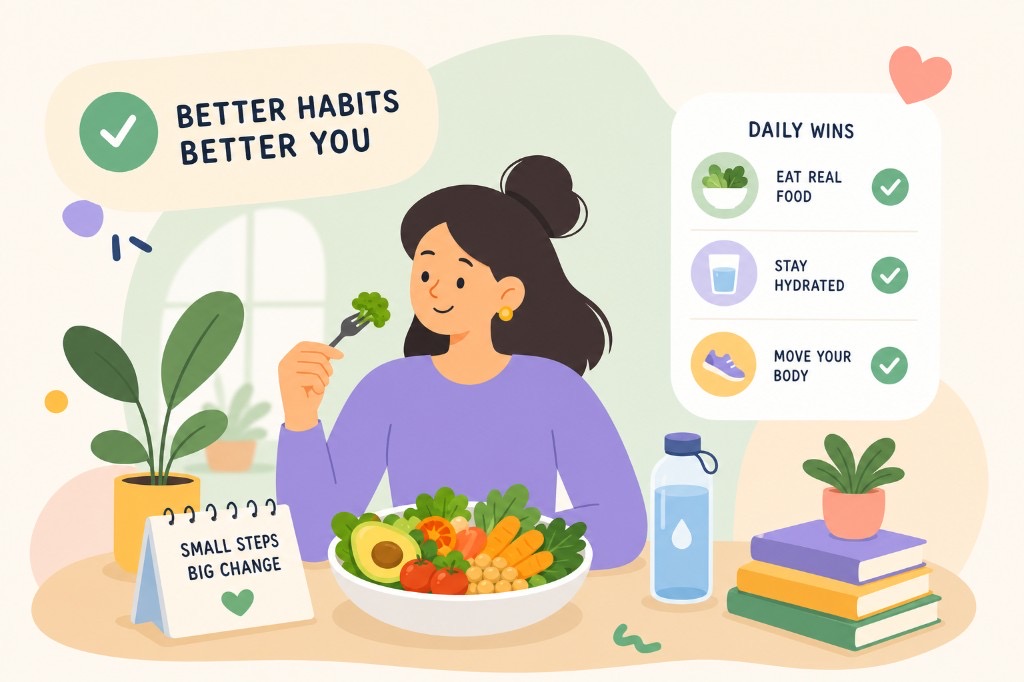
Most people already know they should eat more vegetables, cut back on processed food, and stop skipping meals. The knowledge isn’t the problem. Knowing what to do and actually doing it consistently are completely different—and a lot of advice blurs those two.
Building better eating habits is not a willpower contest. It’s a behavior design problem. Once you approach it that way, the whole process becomes less frustrating and a lot more predictable. This article gives you a step-by-step framework grounded in nutrition science for changing how you eat, and it keeps things honest: research shows dietary habits often take closer to two months to form, not two weeks. The plan below respects that timeline and breaks it into six manageable weeks so you’re never guessing what to do next.
If you want daily accountability without the friction of manual tracking, Eattie works as a pocket nutrition coach: snap a photo of your meal, and you get an instant nutritional snapshot—no database searching, no manual entry required. The framework below works regardless of what tools you use.
Why most eating habit changes collapse in week two
The willpower myth that keeps setting you back
Most people approach healthy eating as a discipline challenge. They commit hard, eat perfectly for a few days, and then the moment life gets difficult, the plan unravels. This isn’t a character flaw; it’s a predictable result of using the wrong mechanism. Relying mainly on effortful self-control as your primary driver for dietary change is a core reason habits fail. Building healthier eating habits without obsession outlines practical behavior-design alternatives that research supports.
Research paints a clear picture of why people struggle: many cite lack of motivation or cost—but underneath both, the deeper issue is often structural. Trying to overhaul too much at once and then depending on daily motivation rarely holds up.
What’s actually missing: a reliable behavior loop
What drives lasting change is a stable cue-routine-reward loop. A cue is an existing trigger in your day—something already automatic, like making coffee or arriving home from work. A routine is the new behavior you attach to it. A reward is a small, immediate reinforcement that makes the brain want to repeat the pattern.
Without a stable cue, new eating behaviors fade quickly because they rely on remembering rather than responding. Eating a healthy breakfast works when it’s tied to something you already do automatically. It falls apart when it lives entirely in your head as a good intention. Building better eating habits requires structural changes, not motivational ones.
How habit science helps you build better eating habits
What the research says about realistic timelines
Popular advice often claims habits form in twenty-one days. Peer-reviewed summaries suggest dietary habits commonly need longer—for example, one 2024 systematic review reported median formation around fifty-nine to sixty-six days, with timelines varying substantially by complexity and repetition. Effect sizes for habit-based dietary interventions in that synthesis were meaningful—not magic, but a sign the mechanism works when you persist.
Framing patience as a strategy—not a weakness—changes how you respond to slow progress. Small, consistent actions compound over eight-plus weeks into genuine behavior change. The first two weeks are about setting up the system, not producing dramatic results.
Building your personal cue-routine-reward loop for eating
Start by identifying one anchor event in your existing day: waking up, your lunch break, arriving home, or making your evening tea. Then attach exactly one new food behavior to it—small enough that it feels almost too easy.
When I make my morning coffee, I also set out one piece of fruit is a real anchor habit. When I get home from work, I pre-portion tomorrow’s snacks is another.
The reward doesn’t need to be food-related. It can be as simple as checking a box, logging a streak, or taking a moment to notice that you followed through. Habit-formation research consistently shows that non-food reinforcement—completion cues, tracking streaks, simple acknowledgment—is enough to keep the loop alive long enough for behavior to become more automatic.
Mindful eating strategies
Eating without distraction: the habit that moves the needle
Mindful eating doesn’t require meditation retreats or elaborate rituals. The practical version is straightforward: eat without a screen in front of you, slow your chewing, and pay attention to when you start feeling full.
Multiple randomized trials on mindful eating suggest this approach can reduce binge eating and emotional eating in people who struggle with portion control—for that population, it often proves helpful alongside (or compared with) rigid macro-tracking alone.
The mechanism is simple: it takes time for fullness signals to reach your brain. When you eat quickly and distracted, you’re often ahead of that signal. Slowing down closes the gap. For many people, this reduces intake without deliberate restriction.
Meal consistency: timing matters more than perfection
Eating at consistent times each day can help regulate hunger patterns and chip away at decision fatigue that leads to impulse choices—your body appreciates rhythm more than heroic perfection.
A consistent routine doesn’t require flawlessness—just repeatability. Three meals at roughly the same time each day, with a planned snack if needed, builds a rhythm. Many people notice fewer “out of nowhere” cravings and clearer hunger versus boredom cues. These shifts compound quietly rather than demanding dramatic change upfront.
Removing friction from healthy choices
Practical meal swaps instead of deprivation
The most sustainable nutrition shifts are swaps, not restrictions. Replacing half the meat in tacos with rinsed canned beans boosts fiber and cuts cost—beans add substantial protein.
Swapping Greek yogurt for sour cream cuts fat while adding protein. Choosing oats over very sugary cereals, or whole fruit over juice, improves nutrient density while keeping routines familiar.
Higher fiber, more protein, and fewer added sugars can improve energy steadiness within the first weeks—even before visible scale changes dominate the story.
Environment design: make the right choice easy
Choice-architecture evidence consistently reinforces a simple lesson: under stress or fatigue, the easiest available option usually wins.
Make the healthier path the lazy path: fruit visible on the counter, chopped vegetables eye-level in a clear container in the fridge, grab-and-go snacks you feel good about. Push less-aligned options farther out of autopilot reach.
Having proteins cooked ahead, sheet-pan meals ready, grains batch-cooked—you’re not begging motivation to arrive at seven p.m.; the decision is already leaning your way.
Your six-week action plan: week by week
Weeks 1–2: Audit baseline and add one anchor habit
Observe before overhauling. Notice which meals repeat and which are reactive. Identify your two or three most reliable daily cues. Attach exactly one small food behavior.
Tools such as Eattie and comparisons in our guide to best food tracking apps for iOS in 2026 explain how photo-based logging slashes friction—capturing baseline data you’ll actually collect.
Weeks 3–4: Layer structure without rigidity
Introduce light planning: two or three go-to meals you can assemble on autopilot, batch proteins, curated snacks, carbohydrate bases stocked—fewer panic decisions.
You’re shifting from reactive to proactive: arriving hungry with a gentle plan already wired in.
Weeks 5–6: Accountability and honest review
Review what eased friction—and what didn’t. Celebrate process wins (showing up, swapping one meal pattern, respecting your cues), not scale-only scorekeeping.
Remember: median timelines for dietary automaticity skew past the one-month mark—pushing slightly further is realistic. Streak dashboards and reflections can reinforce the cue without becoming an obsession (more on consistency without burnout).
What to realistically expect early on
Physical changes: modest signals
Short-window dietary shifts in studies sometimes show modest early weight shifts alongside metabolic clues—often alongside water fluctuation stories. Hunger regulation, steadier energy, and GI comfort commonly improve before averages look dramatic.
Behavioral shifts: better success metrics than perfection
Within weeks of repetition, impulse decisions often thin out—not primarily because discipline skyrocketed, but because cues and surroundings shoulder more load.
When you slip—and you will—the cue is still your reset. Missing once doesn’t erase the habit; abandoning structure does.
The bottom line
Building better eating habits is a design problem: anchor to existing cues, reduce friction in your surroundings, swap before you restrict—and give timelines the respect research suggests.
The six-week map is scaffolding. Real momentum compounds afterward.
Try Eattie if you want photologging plus coaching without spreadsheets—then iterate this framework alongside your schedule.
Note: This article is for general wellness information only—not medical nutrition therapy. Discuss condition-specific diets with your clinician.